Table of Contents
Key Takeaways
- Build wealth through disciplined long-term investing.
- Diversification helps manage risk.
- SIP Investment encourages investing consistency.
- Financial Planning should align investments with life goals.
- Periodic portfolio reviews are essential.
Should I Invest a Lump Sum or Through SIP?
Introduction
One of the most common questions investors ask is whether they should invest a large amount at once or invest gradually through a Systematic Investment Plan (SIP). Both approaches are widely used and can play important roles in Financial Planning. However, the right choice often depends on an investor's financial goals, available capital, time horizon, and comfort with market fluctuations.
KRM Investments, established in 1997, has guided investors through multiple market cycles and changing economic conditions. Over the years, one lesson has remained consistent: successful investing is less about finding a perfect strategy and more about selecting an approach that aligns with long-term financial objectives and personal circumstances.
Many investors assume that one method is universally better than the other. In reality, both lump sum investing and SIP Investment have advantages and considerations. Understanding how each works can help investors make informed decisions that support their broader Investment Planning goals.
Whether an investor is pursuing Retirement Planning, Wealth Management, children's education funding, or Long-Term Wealth Creation, choosing the appropriate investment approach can improve consistency and confidence.
In this article, we explore the differences between lump sum investing and SIP Investment, discuss their roles in Financial Planning, and explain how investors can determine which strategy may be suitable for their needs.
Table of Contents
- Why This Decision Matters
- Understanding Lump Sum Investing
- Understanding SIP Investment
- Advantages of Lump Sum Investing
- Advantages of SIP Investment
- Role of Financial Planning
- Common Mistakes Investors Make
- How Investors Should Choose Between the Two
Why This Decision Matters
The choice between lump sum investing and SIP Investment influences how money enters the market and how investors experience their investment journey.
Some investors receive bonuses, inheritances, business proceeds, or other significant amounts that can be invested immediately. Others prefer to invest gradually from regular income.
Because both approaches involve different experiences and considerations, understanding their characteristics helps investors align investment decisions with financial goals and risk comfort.
The decision should be based on personal circumstances rather than market predictions or popular opinions.
This is why Financial Planning plays an important role in determining the most suitable approach.
Understanding Lump Sum Investing
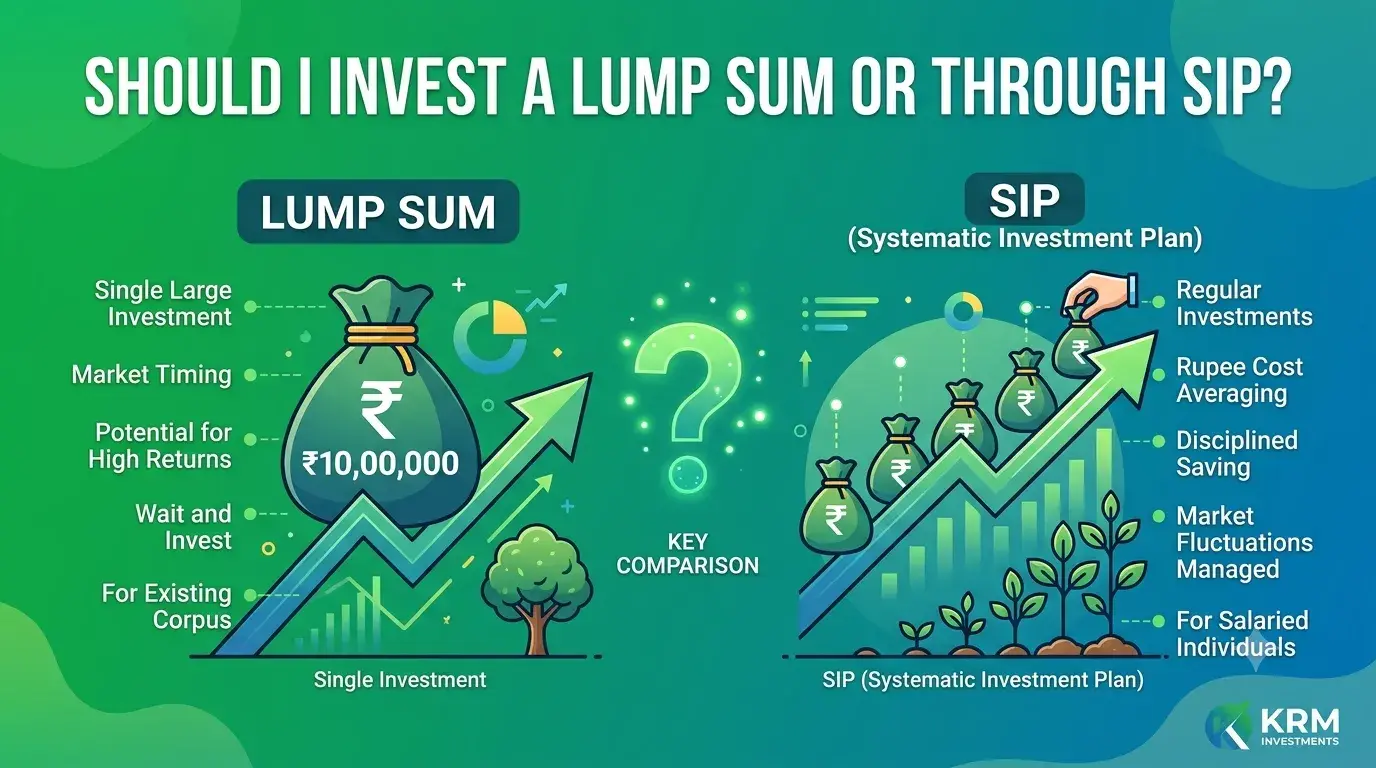
Lump sum investing involves investing a substantial amount of money at one time rather than spreading investments across multiple contributions.
This approach is often used when investors have access to a significant amount of capital and wish to put that money to work immediately. Examples include investment proceeds, accumulated savings, bonuses, or inheritances.
Because the entire amount is invested at once, the portfolio becomes exposed to market movements immediately. Future outcomes may therefore be influenced by market conditions after the investment is made.
Lump sum investing can be appropriate for investors with long investment horizons and a clear understanding of their financial objectives.
However, it may also create emotional challenges if markets experience volatility shortly after the investment is made.
Understanding SIP Investment
SIP Investment involves investing a fixed amount at regular intervals, typically monthly, into Mutual Funds or other eligible investment vehicles.
Rather than investing a large amount all at once, investors contribute gradually over time. This creates a structured and disciplined investment process.
SIP Investment is often favored by investors who receive regular income and wish to build wealth consistently while maintaining financial flexibility.
The approach encourages long-term participation and helps investors focus on their goals rather than short-term market fluctuations.
For many individuals, SIPs become a practical way to integrate investing into everyday financial habits.
Advantages of Lump Sum Investing
Lump sum investing offers several potential advantages within an Investment Planning strategy.
- The entire amount begins participating in the market immediately.
- Investors do not need to manage ongoing contribution schedules.
- Long investment horizons provide more time for compounding to operate.
- The strategy can be useful when substantial capital becomes available.
- Goal-Based Investing objectives may benefit from immediate allocation of funds.
For investors who are comfortable with market fluctuations and have clearly defined goals, lump sum investing can become an effective component of Financial Planning.
However, investors should ensure that decisions are aligned with overall financial objectives rather than short-term market expectations.
Advantages of SIP Investment
SIP Investment is widely used because it promotes consistency and discipline. Rather than requiring large amounts of capital, it allows investors to build portfolios gradually.
Key benefits of SIP Investment include:
- Encouraging regular investing habits.
- Supporting long-term Financial Planning goals.
- Reducing the pressure associated with market timing.
- Aligning well with Goal-Based Investing strategies.
- Making investing accessible through manageable contributions.
- Helping investors remain disciplined during market volatility.
SIPs are particularly valuable for investors seeking to build wealth steadily over time while maintaining a structured investment process.
This approach often fits naturally into Retirement Planning and Long-Term Wealth Creation strategies.
Role of Financial Planning
Financial Planning provides the framework needed to determine whether lump sum investing, SIP Investment, or a combination of both aligns with an investor's objectives.
Rather than focusing solely on investment methods, Financial Planning considers goals, timelines, liquidity requirements, risk tolerance, and future financial needs.
Some investors may use lump sum investments for certain objectives while simultaneously maintaining SIPs for ongoing wealth creation. Others may prefer a single approach depending on their circumstances.
Goal-Based Investing further strengthens decision-making by connecting investment choices directly to meaningful financial outcomes.
A structured planning process ensures that investment decisions remain aligned with broader financial priorities.
Common Mistakes Investors Make
Investors sometimes make avoidable mistakes when choosing between lump sum investing and SIP Investment.
- Attempting to predict short-term market movements.
- Delaying investments while waiting for perfect conditions.
- Investing without clear financial goals.
- Ignoring risk tolerance.
- Stopping SIP contributions during volatile periods.
- Making decisions based on emotions.
- Failing to review Financial Planning objectives.
- Overlooking Retirement Planning needs.
- Focusing only on recent market performance.
- Neglecting diversification and Wealth Management principles.
Avoiding these mistakes can help investors maintain consistency and improve decision quality.
How Investors Should Choose Between the Two
Investors should begin by evaluating their financial situation, available capital, investment horizon, and long-term objectives. The choice between lump sum investing and SIP Investment should support broader Financial Planning goals rather than short-term market opinions.
Those with significant available capital may consider lump sum investing as part of a structured strategy. Investors seeking gradual portfolio building and disciplined investing habits may find SIP Investment particularly appealing.
In many cases, a combination of both approaches may be appropriate depending on financial circumstances and specific goals.
Regular reviews help ensure that investment strategies remain aligned with evolving needs and priorities.
There is no universal answer to whether lump sum investing or SIP Investment is better. Both approaches can contribute meaningfully to Financial Planning, Goal-Based Investing, Retirement Planning, Wealth Management, and Long-Term Wealth Creation. The most effective choice is the one that aligns with an investor's goals, risk comfort, time horizon, and commitment to disciplined investing. By focusing on long-term objectives rather than short-term market movements, investors can build stronger foundations for financial success and confidence.
Important Note
Every investor has different financial goals, investment horizons and risk tolerance. Investment decisions should always be aligned with your overall Financial Planning strategy.
💡 Pro Tip
Investing consistently through SIPs and reviewing your portfolio annually generally produces better long-term outcomes than trying to time the market.