Table of Contents
- Table of Contents
- Understanding Market Cycles
- The Late 1990s Bull Market: Opportunity and Excess
- The Dot-Com Crash: The Cost of Speculation
- The 2003–2007 Expansion Phase: Rewarding Patience
- The Global Financial Crisis of 2008
- The Recovery Decade and SIP Revolution
- The COVID-19 Market Shock
- The New Era of Investing
- Timeless Wealth Creation Lessons from Every Market Cycle
- Practical Strategies for Modern Investors
- Frequently Asked Questions
- Conclusion
- Build Your Financial Future with Confidence
Key Takeaways
- Build wealth through disciplined long-term investing.
- Diversification helps manage risk.
- SIP Investment encourages investing consistency.
- Financial Planning should align investments with life goals.
- Periodic portfolio reviews are essential.
Wealth Creation Lessons from Every Market Cycle Since 1997
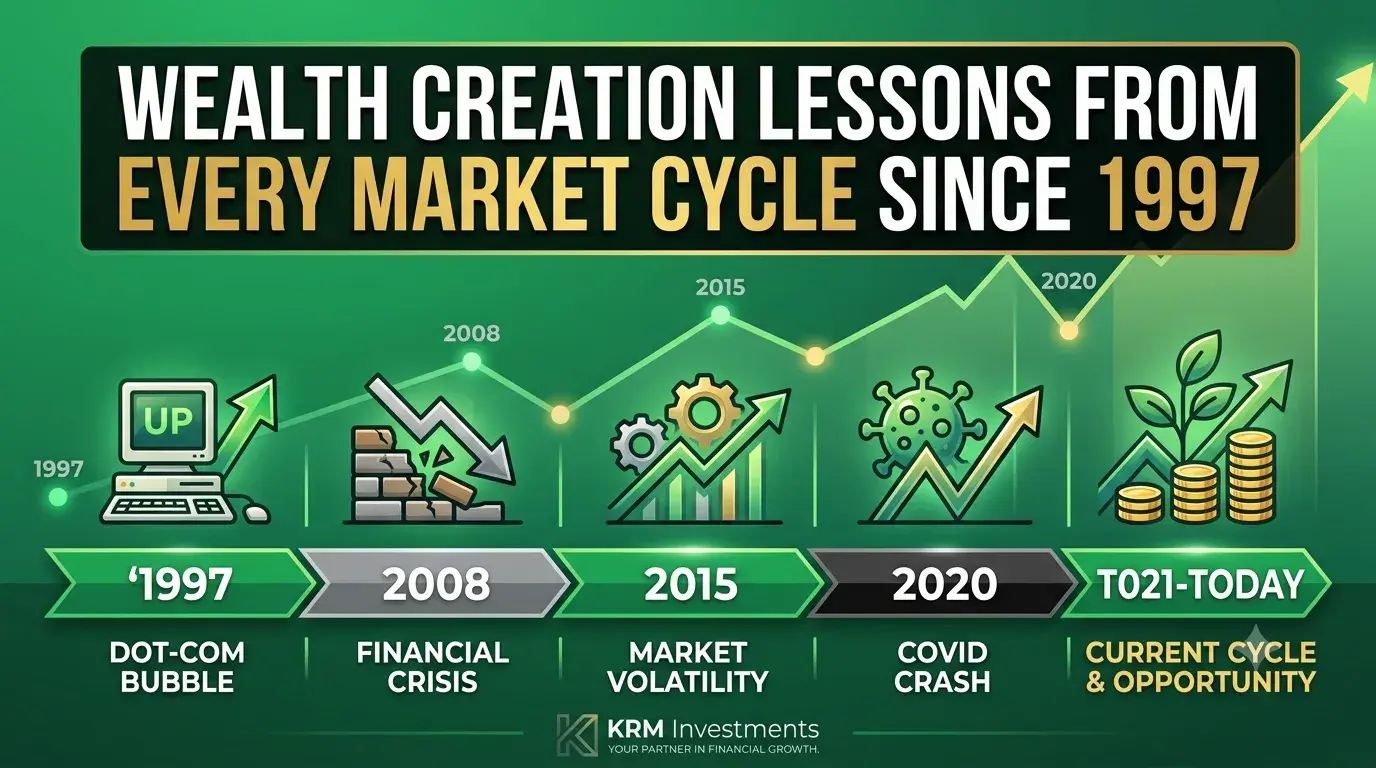
Since 1997, investors have witnessed multiple market booms, crashes, recoveries, global crises, technological revolutions, and economic transformations. Through all these changes, one principle has remained remarkably consistent: long-term wealth creation favors disciplined investors over emotional market timers. Every market cycle offers valuable lessons that can help individuals make better financial decisions and build sustainable wealth.
At KRM Investments, established in 1997, we have observed how different market environments affect investor behavior. While headlines and short-term events often dominate attention, true financial success comes from understanding market cycles, maintaining discipline, and following a structured financial planning approach.
Table of Contents
- Understanding Market Cycles
- The Late 1990s Bull Market
- The Dot-Com Crash Lessons
- The 2003–2007 Expansion Phase
- The Global Financial Crisis of 2008
- The Recovery Decade and SIP Revolution
- The COVID-19 Market Shock
- The New Era of Investing
- Timeless Wealth Creation Lessons
- Practical Strategies for Modern Investors
- Frequently Asked Questions
- Conclusion
Understanding Market Cycles
Market cycles are recurring phases of expansion, peak, contraction, and recovery. While no two cycles are identical, investor psychology often follows similar patterns. Optimism leads to enthusiasm, enthusiasm turns into euphoria, euphoria is followed by fear, and eventually confidence returns.
Successful investors understand that market cycles are normal. Rather than trying to predict every movement, they focus on long-term goals, diversification, asset allocation, and consistent investing through various economic environments.
The Late 1990s Bull Market: Opportunity and Excess
The late 1990s were characterized by strong economic growth, technological innovation, and increasing investor participation. Technology stocks dominated headlines, and many investors believed that traditional valuation measures no longer mattered.
During this period, many portfolios experienced rapid growth. However, excessive optimism also led to speculation. Investors often chased popular stocks without considering fundamentals.
Lesson #1: Avoid Following the Crowd
Popular investments can generate excitement, but investment decisions should be based on research, risk tolerance, and long-term objectives. Wealth creation requires discipline rather than speculation.
Markets can remain optimistic for extended periods, but fundamentals eventually matter.
The Dot-Com Crash: The Cost of Speculation
The early 2000s brought a harsh reality check. Many technology companies failed, and markets experienced significant declines. Investors who concentrated heavily in speculative assets faced substantial losses.
The dot-com crash demonstrated how quickly market sentiment can change. Investors who diversified their portfolios generally experienced less severe declines compared to those focused on a single sector.
Lesson #2: Diversification Protects Wealth
Diversification remains one of the most effective risk management tools available. By spreading investments across asset classes, sectors, and investment styles, investors can reduce the impact of any single market event.
- Reduce concentration risk.
- Improve portfolio stability.
- Enhance long-term investment outcomes.
- Support emotional discipline during volatility.
The 2003–2007 Expansion Phase: Rewarding Patience
Following the dot-com crash, markets gradually recovered and entered a strong growth phase. Investors who remained invested despite earlier declines benefited significantly from the subsequent expansion.
This period highlighted an important truth: recoveries often begin when investor confidence remains low. Those who exited markets after losses frequently missed substantial gains.
Lesson #3: Recovery Rewards Patient Investors
Market recoveries are often unpredictable. Missing even a few strong recovery periods can significantly reduce long-term returns. Staying invested allows investors to participate when markets rebound.
The Global Financial Crisis of 2008
The 2008 financial crisis became one of the most significant economic disruptions in modern history. Global markets experienced severe declines, and uncertainty dominated financial discussions.
Many investors questioned whether markets would recover. Yet history once again demonstrated the resilience of economies and financial markets.
Lesson #4: Emotional Decisions Can Be Expensive
Fear-driven selling during major downturns often locks in losses. Investors who maintained discipline and continued investing generally benefited from the subsequent recovery.
Financial planning should anticipate periods of uncertainty. A well-designed investment strategy includes risk management measures that help investors remain committed during difficult times.
The Recovery Decade and SIP Revolution
The decade following the financial crisis witnessed one of the longest periods of wealth creation in modern investment history. During this period, Systematic Investment Plans (SIPs) gained widespread popularity among Indian investors.
SIPs helped investors participate in markets consistently without worrying about short-term timing decisions.
Lesson #5: Consistency Beats Timing
SIP investing demonstrates the power of disciplined investing. By investing regularly, investors benefit from rupee cost averaging and reduce the impact of market volatility.
- Disciplined investing habit.
- Reduced timing risk.
- Compounding over long periods.
- Affordable investment approach.
- Goal-oriented wealth creation.
The COVID-19 Market Shock
The COVID-19 pandemic created unprecedented uncertainty across global markets. Sharp declines occurred within weeks, creating fear among investors worldwide.
However, markets also demonstrated remarkable resilience. Significant recoveries followed as economies adapted and businesses evolved.
Lesson #6: Volatility Is Temporary
Every crisis feels unique when it occurs, yet history consistently shows that markets eventually adapt. Long-term investors who remained committed to their plans generally benefited from the recovery phase.
Temporary market declines are often the price investors pay for long-term wealth creation.
The New Era of Investing
Recent years have brought inflation concerns, rising interest rates, geopolitical uncertainties, and rapid technological advancements. Investors now have greater access to information, investment products, and digital platforms than ever before.
Despite these changes, the principles of successful investing remain largely unchanged.
Lesson #7: Focus on Principles, Not Predictions
Forecasts frequently change, but sound investment principles remain relevant across different market environments. Investors should focus on asset allocation, diversification, goal-based investing, and long-term planning rather than attempting to predict every market movement.
Timeless Wealth Creation Lessons from Every Market Cycle
1. Start Early
Compounding rewards time. Investors who begin early often require smaller contributions to achieve the same financial goals.
2. Stay Invested
Long-term participation allows investors to benefit from economic growth and market recoveries.
3. Follow a Financial Plan
Structured financial planning provides direction during both positive and negative market environments.
4. Invest According to Goals
Goal-based investing helps align investment decisions with specific objectives such as education, retirement, home ownership, or wealth accumulation.
5. Review but Avoid Overreacting
Regular portfolio reviews are important, but reacting to every market headline can be counterproductive.
6. Manage Risk
Risk management should be a central component of every investment strategy.
7. Seek Professional Guidance
Experienced financial advisors can help investors navigate market cycles with greater confidence and discipline.
Practical Strategies for Modern Investors
A detailed financial plan provides clarity regarding income, expenses, investments, insurance, and long-term objectives.
Emergency savings can reduce the likelihood of selling investments during unfavorable market conditions.
Mutual funds offer professional management and diversification benefits that support long-term wealth creation.
Retirement planning should begin early to maximize the benefits of compounding and long-term investing.
Tax-saving investments can improve overall portfolio efficiency while supporting long-term financial goals.
Frequently Asked Questions
1. What is a market cycle?
A market cycle refers to recurring phases of growth, peak, decline, and recovery in financial markets.
2. Why is long-term investing important?
Long-term investing allows investors to benefit from compounding and participate in market recoveries.
3. How do SIPs help during market volatility?
SIPs promote consistent investing and help average purchase costs over time.
4. Can market crashes be predicted?
Accurately predicting market crashes is extremely difficult. Most investors benefit more from preparation than prediction.
5. What role does diversification play?
Diversification reduces portfolio concentration risk and enhances long-term stability.
6. How often should investments be reviewed?
Most investors benefit from periodic reviews, typically annually or when major life events occur.
7. Why is retirement planning important?
Retirement planning helps ensure financial independence during later stages of life.
8. Should investors stop investing during downturns?
Historically, continuing disciplined investments during downturns has often supported stronger long-term outcomes.
Conclusion
Every market cycle since 1997 has reinforced valuable lessons about patience, discipline, diversification, and long-term thinking. While market events, technologies, and economic conditions evolve, the fundamental principles of wealth creation remain remarkably consistent.
Investors who focus on financial planning, maintain diversified portfolios, continue investing through uncertainty, and align investments with long-term goals are often better positioned to build sustainable wealth over time.
Build Your Financial Future with Confidence
At KRM Investments, we have guided investors through multiple market cycles since 1997. Our expertise in mutual funds, SIP planning, retirement planning, wealth management, tax-saving investments, and goal-based investing helps clients stay focused on long-term financial success.
Whether you are beginning your investment journey or refining an existing strategy, a disciplined approach can make a meaningful difference. Connect with KRM Investments today and take the next step toward long-term wealth creation.
Important Note
Every investor has different financial goals, investment horizons and risk tolerance. Investment decisions should always be aligned with your overall Financial Planning strategy.
💡 Pro Tip
Investing consistently through SIPs and reviewing your portfolio annually generally produces better long-term outcomes than trying to time the market.