Table of Contents
Key Takeaways
- Build wealth through disciplined long-term investing.
- Diversification helps manage risk.
- SIP Investment encourages investing consistency.
- Financial Planning should align investments with life goals.
- Periodic portfolio reviews are essential.
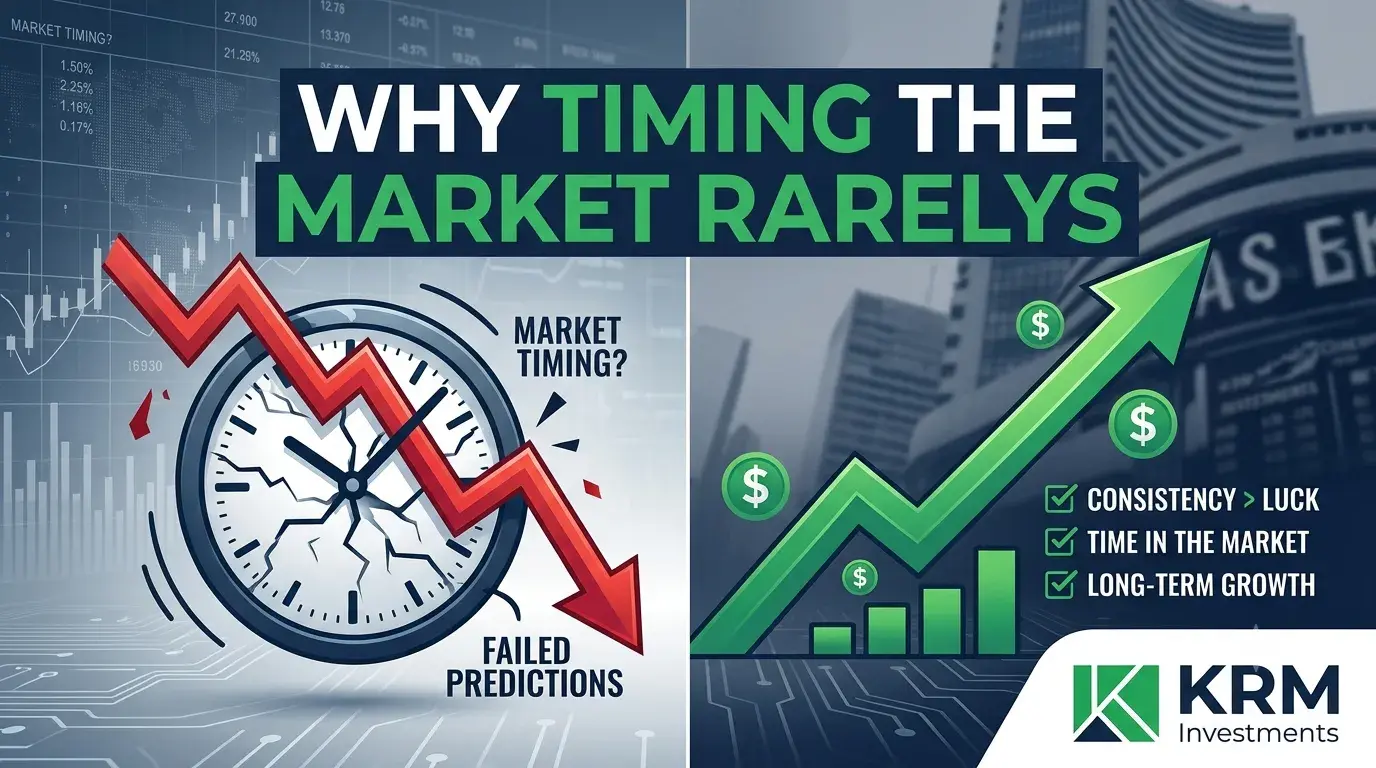
Why Timing the Market Rarely Works
Introduction
Market timing refers to the strategy of trying to predict the best times to enter and exit the financial markets. Many investors believe that by buying at the lowest point and selling at the highest point, they can maximize returns. However, in practice, consistently timing the market accurately is extremely difficult, even for experienced professionals.
At KRM Investments, established in 1997, we have observed across multiple market cycles that investors who attempt to time the market often miss key opportunities for Long-Term Wealth Creation. Emotional decisions, uncertainty, and unpredictable market movements make timing strategies unreliable over the long term.
This article explains why market timing rarely works and how Financial Planning, SIP Investment, and Goal-Based Investing provide a more stable and effective approach to investing.
Table of Contents
- What Is Market Timing?
- Why Investors Try to Time the Market
- Challenges of Market Timing
- Impact of Missing Market Days
- Role of Financial Planning
- Importance of SIP Investment
- Common Mistakes Investors Make
- How Investors Should Approach Markets
- How KRM Investments Helps Investors
What Is Market Timing?
Market timing is the strategy of predicting future market movements to buy low and sell high. It requires accurate forecasting of both entry and exit points in the market.
While it sounds simple in theory, real market behavior is influenced by numerous unpredictable factors, making consistent timing extremely challenging.
Why Investors Try to Time the Market
Investors often attempt market timing due to:
- Desire for higher short-term returns
- Fear of market downturns
- Media influence and market news
- Past experiences of volatility
- Emotional decision-making
Challenges of Market Timing
There are several challenges associated with trying to time the market:
- Markets are unpredictable in the short term
- Missing a few key days can significantly reduce returns
- Emotional bias affects decision-making
- Frequent entry and exit increases costs
- Requires perfect timing twice—entry and exit
Impact of Missing Market Days
One of the most important realities of investing is that missing just a few of the best-performing market days can drastically reduce long-term returns.
Many of these best days often occur during periods of high volatility, when investors are most likely to exit the market.
Role of Financial Planning
Financial Planning helps investors avoid the need for market timing by focusing on long-term goals rather than short-term movements.
It encourages:
- Structured investment strategies
- Goal-Based Investing discipline
- Long-Term Wealth Creation mindset
Importance of SIP Investment
SIP Investment removes the need for timing by investing regularly regardless of market conditions.
This approach helps:
- Avoid emotional decisions
- Benefit from rupee cost averaging
- Build disciplined investing habits
- Stay invested through volatility
Common Mistakes Investors Make
- Trying to predict market highs and lows
- Delaying investments due to uncertainty
- Frequent buying and selling
- Reacting emotionally to news
- Ignoring long-term Financial Planning
How Investors Should Approach Markets
- Focus on long-term Financial Planning goals.
- Use SIP Investment for disciplined investing.
- Avoid reacting to short-term volatility.
- Stay invested across market cycles.
- Prioritize Goal-Based Investing strategies.
- Maintain diversified portfolios.
- Review investments periodically.
- Trust time in the market over timing the market.
Time in the market is more powerful than timing the market.
How KRM Investments Helps Investors
Since 1997, KRM Investments has helped investors build disciplined investment strategies focused on long-term consistency rather than market timing.
We guide investors toward structured Financial Planning that reduces emotional decision-making and supports steady wealth creation.
Our services include:
- Mutual Funds
- SIP Planning
- Financial Planning
- Goal-Based Investing
- Retirement Planning
- Tax Saving Investments
- Wealth Management
We help investors stay focused on Long-Term Wealth Creation instead of short-term market movements.
Important Note
Every investor has different financial goals, investment horizons and risk tolerance. Investment decisions should always be aligned with your overall Financial Planning strategy.
💡 Pro Tip
Investing consistently through SIPs and reviewing your portfolio annually generally produces better long-term outcomes than trying to time the market.